Dune, Clarke, and the Future
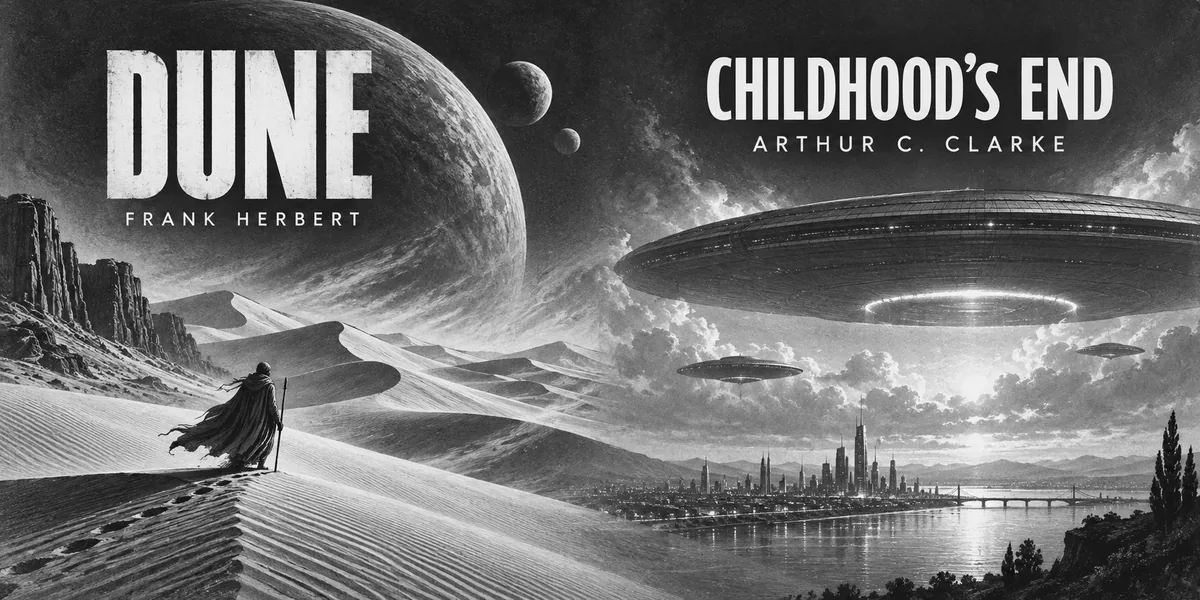
I've been thinking about how well Frank Herbert's Dune and Arthur C. Clarke's Childhood's End imagined the future. My first reaction was that Herbert had been better at it. The stillsuits, the thinking machines, the importance of water. There's plenty in Dune that feels relevant today.
Looking a little closer, Clarke deserves more credit than I initially gave him. He also had a twelve-year head start. Childhood's End was published in 1953, while Dune arrived as a novel in 1965.
The Small Details
Some of Clarke's better predictions are easy to miss. He describes an oral contraceptive and a reliable way to establish paternity through blood analysis. He also considers how those developments would change relationships.
The first birth control pill was approved for contraception in 1960. DNA fingerprinting followed in 1984, making highly reliable paternity testing possible. Clarke didn't describe the DNA technique, and his claim of infallibility was a stretch, but the capabilities he imagined became familiar parts of life.
He also imagined an overwhelming supply of radio and television programming. More entertainment than anyone could possibly keep up with. His concern about people spending their lives consuming it has aged pretty well. Apparently having too much to watch was foreseeable long before we spent an evening scrolling through it.
The Gear
Herbert's stillsuit is the invention that interests me most. A piece of clothing that recovers moisture from your body and gives you drinking water in return. As survival gear goes, that's a pretty useful feature.
We haven't made the Fremen version, but NASA has demonstrated 98 percent water recovery on the International Space Station, using equipment that processes urine and moisture from breath and sweat. Much of the function exists. Getting it into something you can comfortably walk across a desert in is another matter.
Other examples need a little context. Flapping-wing aircraft were an idea long before Herbert, although machines like Festo's SmartBird have since demonstrated what is possible. The first working laser dates to 1960, so lasguns built on technology that already existed.
What Stuck With Me
What I find most convincing about Dune is how the pieces fit together. Water scarcity affects what people wear, how they behave, and what they value. Control of spice gives people power. Better technology hasn't removed greed or made everyone sensible.
Those were recognizable problems when Herbert wrote the book. He thought through how they could shape a distant future. His concerns about dependence on thinking machines feel familiar too, although we certainly haven't followed his society's path of banning them.
Clarke's quieter predictions are easier to overlook because several became ordinary. Herbert's inventions still make me wonder how I'd use them. Both gave some thought to what happens to people once the technology is there. That's the part of these books I find myself coming back to.